I’ve grown a lot in my time as a church school teacher. I took over our church school program because someone simply had to do it. the wonderful couple who had run the program for many years moved away and unless I stepped in there would be no church school program for my own kids. As time progressed and the full scale of my own kids’ special needs became apparent, I began incorporating the pieces of their IEPs and regular school curriculums into our church school setting. Our program may be small, but gosh darn it, it would be accessible to a wide array of learning needs and levels. After using “set” curricula materials for the past 5 years that always needed to be adapted significantly, I started a conversation about what our kids were missing. What are the gaps in their church knowledge? The answer: the great feasts. To meet this gap, I developed a curriculum around the 12 Great Feasts (plus The Lenten Triodian) that will used for the 2020-2021 church school year. As part of their study each child will be putting together a resource binder containing a graphic organizer with information about each feast. Not only will this give us something to present to the parish as a portfolio, but it will also give our kids something to keep. Maybe it won’t work out as well as I hope it will, but at least we will have tried.

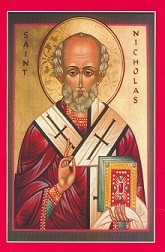
Following in St. Nicholas’ Footsteps
 I love November. The air becomes crisper, colors become more intense, my favorite foods are ready to harvest, and Christmas decorations are out in full force… wait… what was that last one? Christmas in November? Every year Christmas celebrations start earlier; if this keeps up, soon stores will have permanent Christmas displays full of trees, lights, fake snow, and oh so many Santas.
What is the obsession with Christmas? Granted, for many stores it’s about their bottom line. If people will buy, they will sell. Even Hallmark began their Christmas movie marathons in October. If Christmas is indeed “the most wonderful time of the year,” as Andy Williams said, then we’re well on pace to capture that wonderful time year-round.
When asked what they find so compelling about Christmas, people often mention kindness, generosity, and giving. St. Nicholas exemplifies all of these and more. Four years ago when they were 10 years old as part of a church school project, my daughter and her friend prepared an informational brochure about St. Nicholas. This brochure was distributed at Luminary Night (a town event our church does) to share the story of St. Nicholas with our guests, many of whom are only familiar with Santa Claus. I hope you enjoy re-reading their words as much as I have.
One thing St. Nicholas is known for is of course his secret gift giving. Another thing he’s known for is being a bishop. He is known for countless legends about the gift giving. Like the one about a poor widower that has three daughters. They are poor. And the daughters were going to be sold into slavery if they didn’t have these things called dowries. So St. Nicholas came to their house on three different nights and left a pouch of gold. There was enough money for the three girls to get dowries and get married so they wouldn’t get sold into slavery.
Today we commemorate St. Nicholas by putting our shoes or boots somewhere and while we’re sleeping St. Nicholas comes. And when we come down stairs in the morning, we have presents waiting for us. There are three gifts that we always get. The first thing we always get is a candy cane. The second thing that we always get are oranges. The final thing that we always get are chocolate coins. These three things all have special meanings. The candy cane(s) are given because, they are shaped like a bishop’s staff or a shepherd’s crook to remind us of St. Nicholas’s compassion and love for us humans. The oranges and chocolate coins are given because it helps us remember the story of the three daughters.
As Orthodox Christians and families there are activities we can do together during the Nativity season. Just as St. Paul writes in 2 Corinthians 9:7, we should “give as he purposes in his heart, not grudgingly or of necessity; for God loves a cheerful giver.” By encouraging our children to give cheerfully and generously to others we encourage them to follow in St. Nicholas’s footsteps during the Nativity season. Here are a few simple suggestions to kick start your family’s Nativity giving!
- December is a great time for “winter” cleaning! Go through clothes and toys and donate those that are no longer in use.
- Volunteer together at one of your favorite charities. This could range from working at a soup kitchen to collecting donations for an animal shelter.
- Many towns and schools host a “giving tree” or “adopt a family” programs. My daughters have always loved shopping for our adopted families!
- Share our St. Nicholas traditions with your friends and neighbors! Put together a basket with oranges, candy canes, chocolate, small toys for the children, and a note about St. Nicholas and leave it on the front step for them.
- Work together to make gifts for friends, neighbors, postal workers, teacher, and others! Make cookies, fudge, ornaments, jar cookie mixes… really the list is endless! Pinterest has many options for all skill levels.
Most importantly take advantage of family time to read together and discuss traditions and stories. One of my favorites is A Perfect Christmas by Dennis Eugene Engleman. In this story “past and present collide as a modern child meets the real” St. Nicholas and quite literally learns to follow in his footsteps. It’s a perfect story for a child struggling with his beliefs and overwhelmed by our culture’s materialistic focus of the Nativity season. For our church, I added this book to our Children’s Lending Library in the hopes it will be the catalyst for great discussions about giving among our parish families as well!
We will welcome St. Nicholas to our church during December. Just as he will share gifts with our children, they are preparing a gift for him in the form of a short play sharing one of their favorite St. Nicholas stories with both him and our parish family. Just another way for our children to share the spirit of St. Nicholas with our parish family and encourage them to follow in his footsteps as well this Nativity season!
Keeping a Promise
 I’m about to head off on a nearly week long work trip during the height of fall activities. This means an extra church school vacation day for the kiddos (who are more than willing to sacrifice their lessons for a chance to enjoy the crisp fall weather outside). At home it means I am making lists of lists to make sure everything is taken care of and prepped for my absence. There are shared electronic lists so I can check in easily to see if everything is done, paper chains to count down the sleeps until mom is home, and extra chore checklists easily at eye level as an extra reminder for mom’s animal chores.
And while every conversation about the trip may begin with discussions of everyone’s responsibilities, each ends with reassurances about my return. The date, the time, the method are all vitally important to this conversation which invariably ends with my assurance, “remember, mom always comes back.” While my daughters may want reassurances as to when my return will be, they trust and believe in my promise to return because I’ve always followed through on that promise in the past.
My St Mary’s students learned about God’s Promise or Covenant with Abraham during church school this week. Just as my children believe me when I say I’ll come home, Abraham believed God’s promise, no matter how far-fetched it seemed at the time, that he and Sarah would have a child. He was willing to move himself and his wife away from everything they knew to follow this promise. This was a much harder concept for me, an adult, to wrap my head around than for my students. As we’ve been repeating the “mom always comes back” script this week I realized this is because my students are used to trusting their parents’ word. They understand why then Abraham would trust the God he called Abba, or Father. I’m sure when my students are older discussing the same story with their children, they’ll have the same epiphany and will be brought to stunned silence that their children learned the lesson long before it was taught.
 Raising Our Marys and Jacobs